
Where Court Releases Lead
Rio Blanco Combined Court is a court facility operated by the Colorado Judicial Branch. It is included in this facility set because a released-inmate search often reaches a point where the jail record confirms that custody ended, but the reason for release lives in the court file. When a person leaves custody after a Rio Blanco case, the next step may be return to the community, a bond condition, a sentence-served disposition, probation through the 9th Judicial District, transfer to CDOC, or another court-directed result. The Combined Court record helps identify which path applied.
The research describes the court record as the record that outlives the jail stay. That is especially true in Rio Blanco County because no official rolling 24-hour or 72-hour release list was found, and local reporting described changes to jail operations that may place the physical custody entry at a contract facility. The court file remains tied to the Rio Blanco case even when the person was held elsewhere. If the public custody trail is thin, the docket and clerk record can explain the release authority.
Common court events behind a release include bond posted, personal recognizance release, dismissal, sentence served, time served, probation order, deferred sentence, revocation result, warrant recall, mittimus to CDOC, or a sealing order that changes public access later. Not every document is available online, and some records may be restricted by rule or order. The point of this page is to identify the court as the source for court action, not to imply that it maintains a jail roster.
Confirm Release Through Court
Use Rio Blanco Combined Court when you need the legal event behind a release. A current-custody tool may tell you whether someone appears in custody now. A court record can tell you whether a judge ordered release, bond changed, the case ended, probation was imposed, a warrant was recalled, or the person was committed to CDOC. Follow the sequence below when the jail record and court record need to be reconciled.
- Search the Colorado Judicial Branch docket search at coloradojudicial.gov/dockets using the person's name, case number, or hearing information if known.
- Identify the Rio Blanco case and review the docket events for bond, disposition, sentence, probation, warrant, mittimus, or dismissal language.
- Contact the Combined Court clerk when the docket entry is not enough or when you need a public copy of a case document.
- Use Rio Blanco Sheriff records to confirm the jail custody report and actual release date from county custody.
- If the docket shows commitment to CDOC, use the Colorado Department of Corrections offender search for the state-prison or parole side of the record.
- If the person may have been held at Moffat County Detention Center, confirm the physical custody event with the contract facility while keeping the Rio Blanco court file as the case source.
The Rio Blanco County released inmates home page explains how these channels fit together. The court is strongest for orders and case outcomes. The sheriff is strongest for local custody reports. VINE is useful for custody-status notification. CDOC is limited to state correctional custody, parole, and discharge records.
Rio Blanco Combined Court Contact
The Rio Blanco Combined Court location page lists the court at 455 Main Street, P.O. Box 1150, Meeker, CO 81641. The phone number is 970-878-5622, and the listed email is RBCtyMeeker@judicial.state.co.us. The published hours are Monday through Friday from 8:00 a.m. to 12:00 p.m. and 1:00 p.m. to 5:00 p.m. The court page is separate from the sheriff's page and separate from the Meeker Probation Department page, even though all three may be relevant to the same released person.
When contacting the court about a release-related case record, ask for the public docket, bond order, disposition, sentence order, probation order, warrant recall, mittimus, dismissal, or other specific document connected to the release event. If you do not know the exact document, describe the event: for example, a person arrested in Rio Blanco County who stopped appearing in custody after a hearing date. The clerk can direct you to available public case information, subject to court rules, sealing, and other access limits.
The research also notes a Rio Blanco County Associate Court or Rangely court-hours detail on the county court page. That page says the Associate Court in Rangely is open Tuesday and Wednesday from 8:00 a.m. to 12:00 p.m. and 1:00 p.m. to 5:00 p.m., and Thursday from 8:00 a.m. to 12:00 p.m. Use the court's official page or clerk contact to confirm which location applies to the case before relying on a schedule.
Judicial Source Snapshot
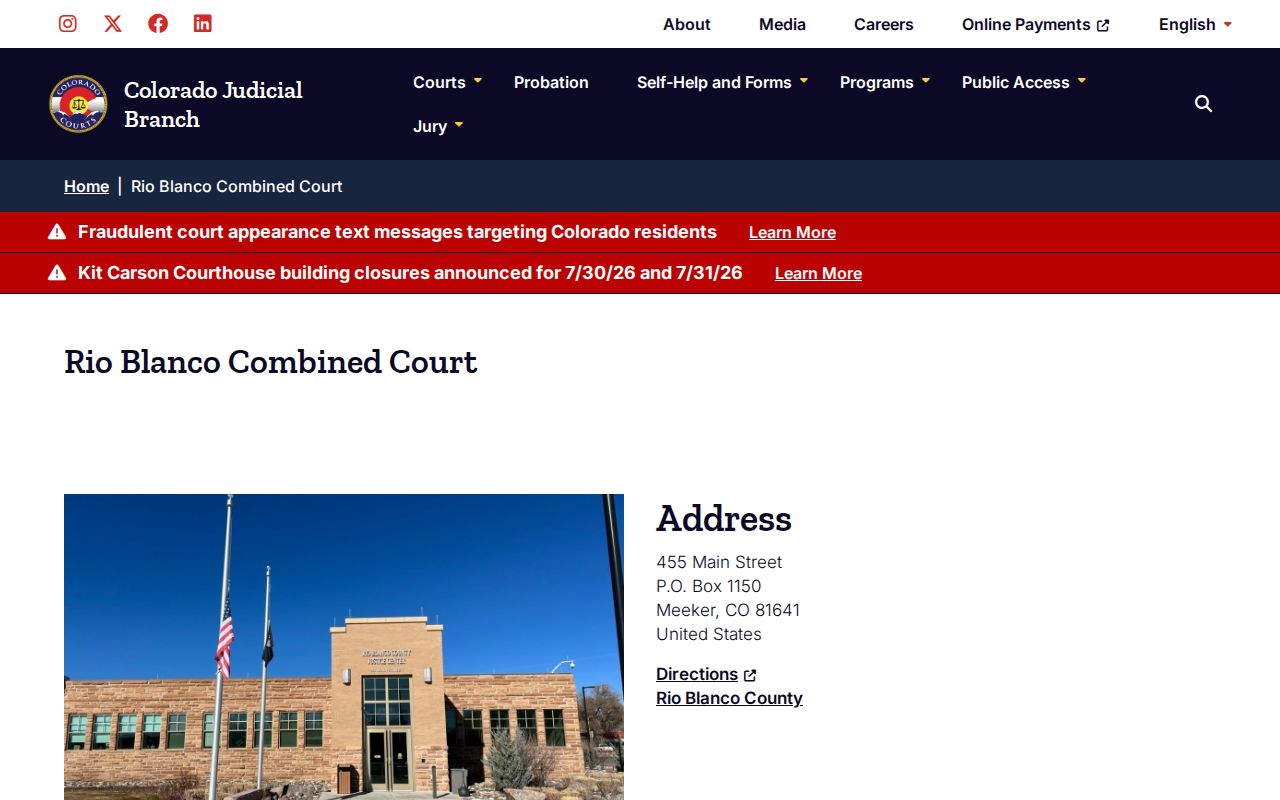
The image below is the manifest capture tied to the official Rio Blanco Combined Court location page used for this court-record page.
About the Court Role
This is not a jail page in the ordinary sense. Rio Blanco Combined Court does not operate the Rio Blanco County Detention Center, Moffat County Detention Center, CDOC, or VINE. Its role is case authority. A person may leave custody because a judge sets bond, recalls a warrant, accepts a plea, imposes probation, credits time served, dismisses a case, or issues a mittimus. Those events are court events, and they can remain searchable or requestable after the jail roster no longer shows the person.
The court record is also the right source for distinguishing probation from parole. Probation is ordered by the court and administered locally through probation services. Parole follows a CDOC prison sentence and is handled through the state parole system. A Rio Blanco release to probation should be checked through the case order and the Meeker Probation Department, not treated as a CDOC parole release unless the court record or CDOC record shows a prison component.
Case Records and Limits
Court records can be more durable than jail records, but they are not unlimited. Some documents are not available through a public docket. Some cases or filings may be sealed, restricted, or available only through a clerk request. A release may be real even when public access later changes. The correct reading is narrow: use the docket and clerk records to verify public court events, then use the sheriff, contract jail, VINE, or CDOC record for custody status.
For Rio Blanco County, the strongest court-to-custody comparison is often three-way. First, check the Combined Court for the legal authority. Second, check Rio Blanco Sheriff records for the county custody report. Third, if the person was held outside Rio Blanco County or moved into state custody, check the physical facility or CDOC. That method prevents two common errors: assuming the court page is a jail locator, or assuming the jail record alone explains the legal reason for release.
If the court record shows probation, use the Meeker Probation Department page and the local probation office for the supervision context. If it shows a mittimus or prison sentence, shift to the CDOC offender search for state correctional status. If it shows bond or a warrant recall, compare that entry with the sheriff custody report to confirm when the person actually left confinement. Each source has a different job, and the release is clearest when the court event and custody event are read together.
When a case later becomes sealed or restricted, public access may change even though the release happened. In that situation, avoid guessing from missing search results. Use the clerk's public-access guidance, the sheriff's records office for custody material that remains available, and any CDOC or probation source that applies to the person's current legal status.